The Church Year
Understanding the Liturgical Calendar
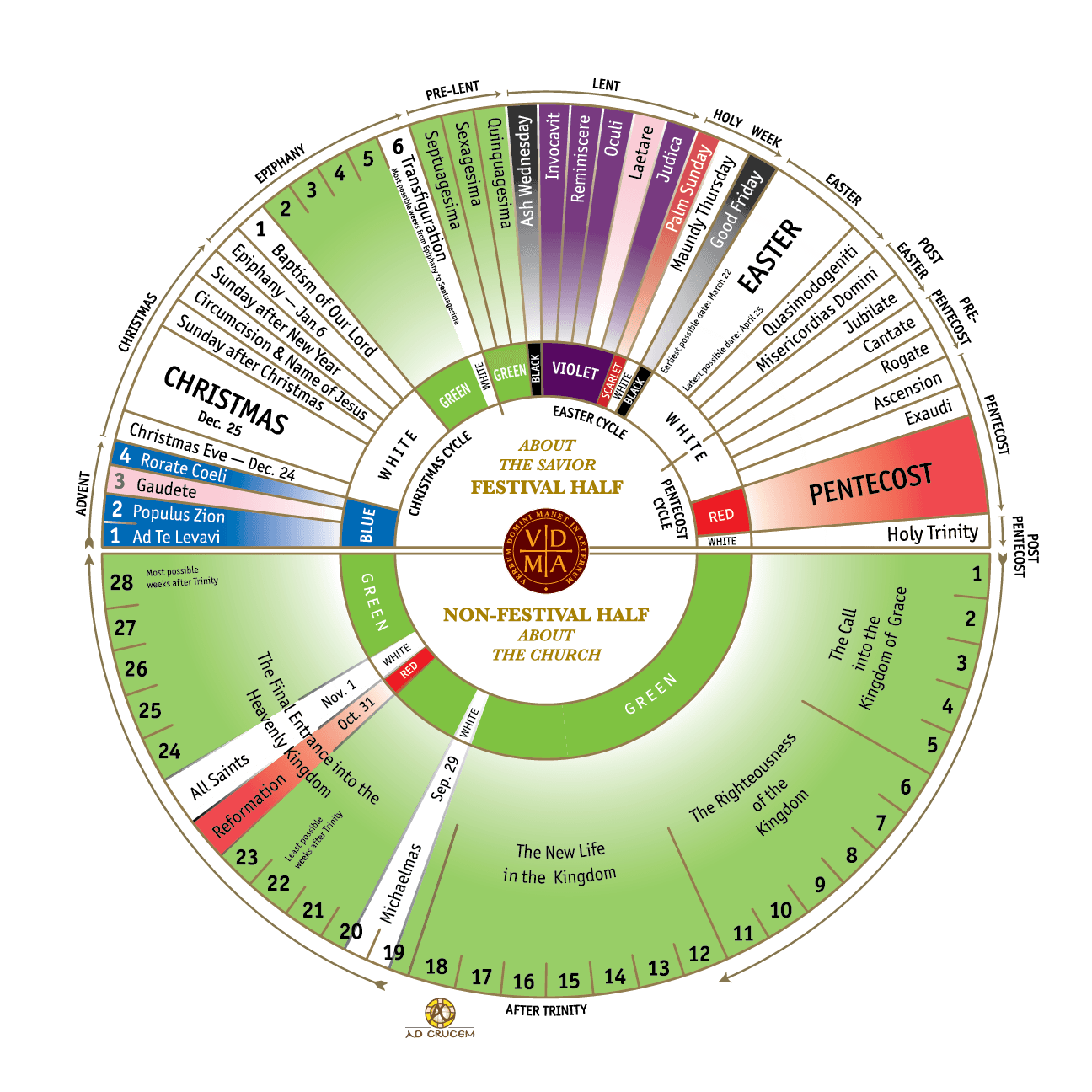
Most Christian congregations follow the "church year" to order our life together and focus on the Divine Service. The Christian year has two parts, divided roughly in half into semesters or half-years.
The Church Year is determined by two cycles: the Solar Cycle and the Lunar Cycle. The Solar Cycle includes fixed-date feasts like Christmas (Dec 25) and Epiphany (Jan 6). The Lunar Cycle determines the date of Easter (the first Sunday after the full moon that occurs on or after the vernal [spring] equinox on March 21 each year. Consequently, all the movable feast dates related to Easter, such as Ash Wednesday, Ascension, and Pentecost, will change from year to year.
Easter can fall as early as March 22 and as late as April 25. This movement affects the length of the Epiphany and Trinity seasons. When Easter is early, the Epiphany season is shorter and the Trinity season is longer (up to 27 Sundays). When Easter is late, the Epiphany season is longer (up to 6 Sundays after Epiphany) and the Trinity season is shorter (as few as 22 Sundays). The First Sunday of Advent can fall as early as November 27 and as late as December 3.
1. The Semester of Christ
From Advent through Easter (winter and spring in the Northern Hemisphere, reversed in the Southern Hemisphere).
This half of the church year focuses on the life, ministry, death, and resurrection of Jesus Christ.
2. The Semester of the Church
From Pentecost through the Last Sunday of the Church Year (summer and fall in the Northern Hemisphere, reversed in the Southern Hemisphere).
This half emphasizes the work of the Holy Spirit in the Church and the Christian life.
The Liturgical Seasons
The church year is organized into distinct seasons, each with its own focus, liturgical color, and spiritual emphasis:
- is blue for the hope of Christ’s coming;
- is white for Christ’s purity and beauty;
- is green for our growth in knowledge of His revelation;
- is purple for repentance and sadness over sin;
- is white for Christ’s victory over death;
- is red for the fire of God’s Spirit;
- is green for continued growth in the life of God.
Church Year information from
The Narrow Way: Simply Shown
Authored by Rev. Dr. Adam Koontz. Now available in Spanish, translated by Rev. Orlando Ramirez; El Camino Estrecho: Simplemente Explicado.
About the Lutheran Missal
The Lutheran Missal project brings to the English-speaking church the historic Lectionary referenced by the Book of Concord—a series of appointed Bible readings, psalm verses, and prayers for the Divine Service throughout the Church Year—along with the rites and resources used by Lutherans in the century following the Reformation.Read more...
Source: Lutheran Missal Project, Site by Ad Crucem